In all the drama of September, the 10-year Treasury yield at a 24-year high, the Nasdaq’s resilience, the Dow’s worst month since March 2023 talk of the bond market, one of the month’s most telling stories slipped by almost unnoticed. The banks are in trouble. Not the kind of trouble that makes headlines with emergency weekend meetings, but the quieter, slower kind: shares sliding week after week, trading floors bracing for weaker quarters, and investors walking away. The S&P 500 financials index fell 6.3% in September, on track for its worst monthly performance since March 2023, BigGo Finance reported. That is a remarkable sentence, because March 2023 was the month of the regional banking crisis. Nothing remotely like that happened this September. And yet the share prices look eerily familiar.
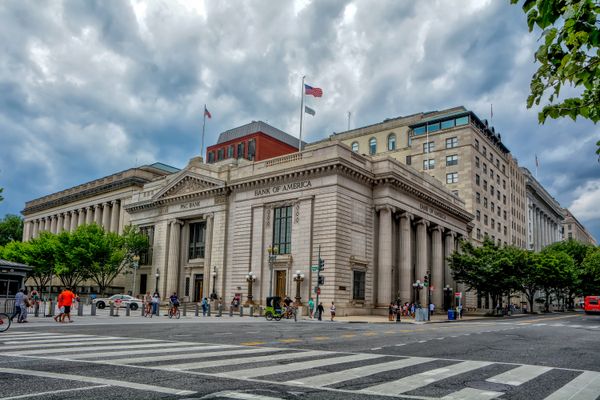
Here is what the damage looks like up close. The KBW Nasdaq Bank Index fell 0.73% in one recent session alone, with Bank of America down 0.92%, JPMorgan Chase down 0.48%, and Citigroup down 0.41%, BigGo Finance reported. Over the full month, the pain was far worse in the capital markets corner of finance: Blackstone, the private equity giant, lost 21% of its value in September, and BlackRock fell 8%, BigGo Finance reported. A 21% monthly decline in the world’s largest alternative asset manager is not a footnote. It is a verdict on what investors think dealmaking looks like at 5.3% long-term rates.
There is a paradox at the heart of this selloff, and it is worth sitting with, because it explains why the conventional wisdom about banks and interest rates keeps failing this year. The old rule of thumb says banks love higher rates: they collect more interest on loans while paying depositors slowly. But the new reality, the one September priced in, is that the level of rates matters less than the path. When rates are high and volatile, and nobody knows whether the Fed hikes again in October or waits until December, companies freeze. They delay issuing bonds. They postpone the mergers they were sketching on whiteboards. And the banks that live on fees from financing and dealmaking starve.
That is exactly what Bank of America’s chief executive, Brian Moynihan, told investors at a Barclays conference earlier this month: quarterly sales and trading revenue would be “flat” relative to a year ago, and investment banking fees were set to decline about 10%, Barron’s reported. “It’ll be one of the better third quarters we’ve ever had, but it’ll be relatively flat to last year, because last year was a big recovery from the second quarter,” he said. His comments spooked shareholders anyway. Bank of America’s stock dropped 5.1% to $59.47 that day, its largest decline since April 2025, dragging Citigroup down 1.9%, JPMorgan 1.7%, and Goldman Sachs 3.9%, Barron’s reported. One word, “flat,” and billions in market value vanished, because the market had priced in a boom.
The banks themselves have been telling a two-speed story all month. JPMorgan Chase expects trading revenue to deliver high double-digit growth year over year in the third quarter. Citigroup forecasts a mid-single-digit increase in markets revenue. Both are better than Bank of America’s roughly flat expectation, but all of them remain well below the torrid growth of the second quarter, Mitrade reported. Goldman Sachs CEO David Solomon said the firm’s equities business remains strong, but revenue from fixed income, currencies, and commodities will be slightly weaker, Mitrade reported. Translation: the trading boom that carried the first half of the year is cooling, and the part of the bank that was supposed to pick up the slack, underwriting and dealmaking, is fading instead.
There is a second pressure building that gets less attention but may matter more. The spread between the yield on the 2-year Treasury note and the benchmark 10-year Treasury note has narrowed to just 22 basis points, less than half the 54-basis-point spread of a year ago, according to FactSet data cited by MarketWatch. Banks earn money by funding longer-term assets, like loans, with shorter-term liabilities, and when the spread between the two narrows, they make less money. On a day earlier this month when that narrowing spooked investors, Charles Schwab sank 6.8%, JPMorgan dropped 4.1%, Bank of America shed 2.9%, and Citigroup fell 3.1%, while the State Street Financial Select Sector SPDR ETF dropped 2.3%, MarketWatch reported. That is the mechanics of bank profitability working against them: higher rates should widen the spread, but when short-term rates stay pinned high by Fed policy while long-term rates are driven by debt supply and inflation fears, the curve flattens and the banks’ core engine sputters.
And then there is the credit question, the one nobody wants to ask first. Rising long-term yields erode loan demand and raise borrowing costs for the companies banks lend to. Mohamed El-Erian, the chief economic adviser at Allianz, warned this week that the protracted surge in sovereign bond yields is driven by forces far beyond energy markets, and that it is “increasingly only a matter of time before borrowing costs for households and corporates face the additional headwind of even wider credit spreads,” Stocktwits reported. In plain language: borrowers who could handle 5% rates may not handle 5% rates plus wider credit spreads, and banks own the loans to those borrowers.
It helps to put September’s bank slide next to the one bank stocks avoided. In March 2023, the problem was deposits: money fleeing regional banks, balance sheets under water, confidence collapsing overnight. This time, deposits are not the story. The balance sheets are not in question. What September priced in is something slower and harder to fix: an earnings outlook that keeps dimming as rates stay high and volatile. Companies need relatively stable financing costs to make debt issuance decisions, and investors keep reevaluating banks’ future trading revenue, underwriting revenue, and net interest margins as the policy path shifts beneath them, Mitrade reported. Moynihan himself noted that once rates stabilize, dealmaking should recover. Stabilization is the whole game now.
Here is my take, and I will label it as mine. The market is treating this bank selloff as a valuation adjustment, and maybe it is. The big banks remain profitable, well-capitalized, and nowhere near the March 2023 kind of stress. But a 6.3% monthly decline in the sector and a 21% collapse in Blackstone are not just noise. They are the market telling us that the economy’s plumbing, the financing, the dealmaking, the lending that turns plans into projects, is under real pressure from rates that will not come down. The fourth quarter will test that verdict directly: the big banks report third-quarter earnings in mid-October, and the question will be whether the trading floors and deal teams can still deliver when the market has stopped believing in the boom.
For anyone watching their own money, the signal is practical, not just academic. Bank stocks are often the first to feel credit stress, because they live closest to borrowers. When they fall while the Nasdaq rises, it is the market’s way of saying the boom is narrow and the foundation is strained. September’s banks did not crash. But they warned. Listen to warnings like that, because the loud crashes rarely give you the courtesy of a warning at all.