
Update — 12:30 CT: Brent crude pulled back sharply at midday after CNN reported President Trump is open to relief from sanctions on Iran if there is real progress on nuclear issues. Brent traded near $97.52 a barrel at midday, well off its morning high of $101.24, and the S&P 500 trimmed its losses to about 0.5%, roughly half its intraday decline, per MarketWatch’s live coverage (https://www.marketwatch.com/livecoverage/stock-market-today-dow-s-p-500-nasdaq-oil-prices-rise-bond-selloff-deepens/card/stocks-bounce-sharply-off-lows-as-oil-prices-take-a-midday-dive-jgYgZhTX7QgrrP5qteNJ).
Wake up to a Monday where everything seems to be pulling in the same uncomfortable direction. As of 8:30am CT, U.S. stock futures are pointing lower, oil is jumping, and Treasury yields are climbing again, the kind of morning that makes you reach for the coffee before you reach for your portfolio.
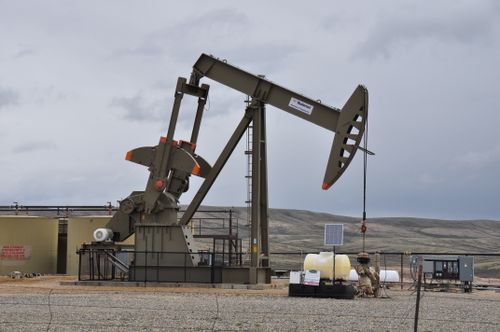
The chain reaction started over the weekend. President Donald Trump rejected an Iranian proposal to reopen the Strait of Hormuz and wind down the conflict, an offer Tehran announced at last week’s United Nations General Assembly and relayed through Qatari mediators, according to Reuters. Trump said Saturday he had turned the offer down, though he told Axios on Sunday that he expects U.S. negotiators to keep talking this week. That single development was enough to send crude prices surging. West Texas Intermediate jumped 2.9% to $95.10 a barrel while Brent crude, the international benchmark, rose 2.6% to $107.05, per Investopedia. The Wall Street Journal put Brent’s November contract up 2.4% at $106.85.
When oil spikes like this, it doesn’t stay an oil story. Expensive energy feeds into everything, from the cost of shipping goods to the price at the pump, and markets quickly start worrying that inflation will stay sticky. That worry showed up in the bond market, where the selloff intensified Monday morning. The 10-year Treasury yield climbed 5.3 basis points to 5.218%, the 30-year gained 3.1 basis points to 5.527%, and the 2-year traded around 4.920%, according to the Journal. Those are fresh multiyear highs. Markets are now pricing in a more than 70% likelihood that the Federal Reserve opts for a quarter-point rate hike next month.
Jefferies economist Mohit Kumar captured the mood in a client note quoted by the Journal: “We believe that we are in a one factor world with oil driving rates and rates driving all asset classes.” LSEG data cited by Reuters shows the 60-day rolling correlation between oil prices and Wall Street futures has climbed to its highest level since late May, a sign that energy markets and equities are dancing to the same anxious drumbeat.
Futures told the same story. At 5:42 a.m. ET, Dow E-minis were down 187 points, or 0.36%, S&P 500 E-minis were down 38 points, or 0.49%, and Nasdaq 100 E-minis were down 304 points, or 0.98%, per Reuters. They bounced off the worst levels as the morning wore on. Less than an hour before the opening bell, S&P 500 futures were down 0.4%, having been off as much as 0.6%, while Nasdaq-100 futures were down 0.6% after falling 1.2% earlier, and Dow futures pointed to a 254-point decline versus 334 at their low, MarketWatch reported.
Overnight, Asia was mostly lower. Japan’s Nikkei 225 fell 0.7% to 65,877.62, South Korea’s Kospi dropped 2.7% to 6,889.74, and China’s Shanghai Composite lost 1.7% to 3,823.62, while Hong Kong’s Hang Seng rose 0.6% to 24,654.86 and Australia’s S&P/ASX 200 added 0.2%, according to the Associated Press. India had a rough day: the Sensex plunged 1,124 points, or 1.52%, to 72,771.72, the Nifty 50 shed 1.56% to 22,780.25, and the rupee slipped 28 paise to 96.03 against the dollar, per The Hindu BusinessLine. Europe, in contrast, edged higher. The Stoxx 600 nudged up 0.35%, France’s CAC 40 added 0.3% to 8,097.99, Germany’s DAX rose 0.2% to 25,464.53, and Britain’s FTSE 100 gained 0.3% to 10,725.57, the Journal noted.
It is a week where one variable, oil, is steering the entire market. Then comes the data gauntlet: the Personal Consumption Expenditures report lands Wednesday morning and the September jobs report follows Friday morning, per Investopedia. As E*TRADE’s Chris Larkin put it in written commentary: “Tech strength has been doing a lot of the heavy lifting for bulls lately, but the broader market hasn’t been able to gain much traction because of rising yields and oil prices.”
Keep an eye on the diplomacy, the data, and the price at the pump. They are all telling the same story now.